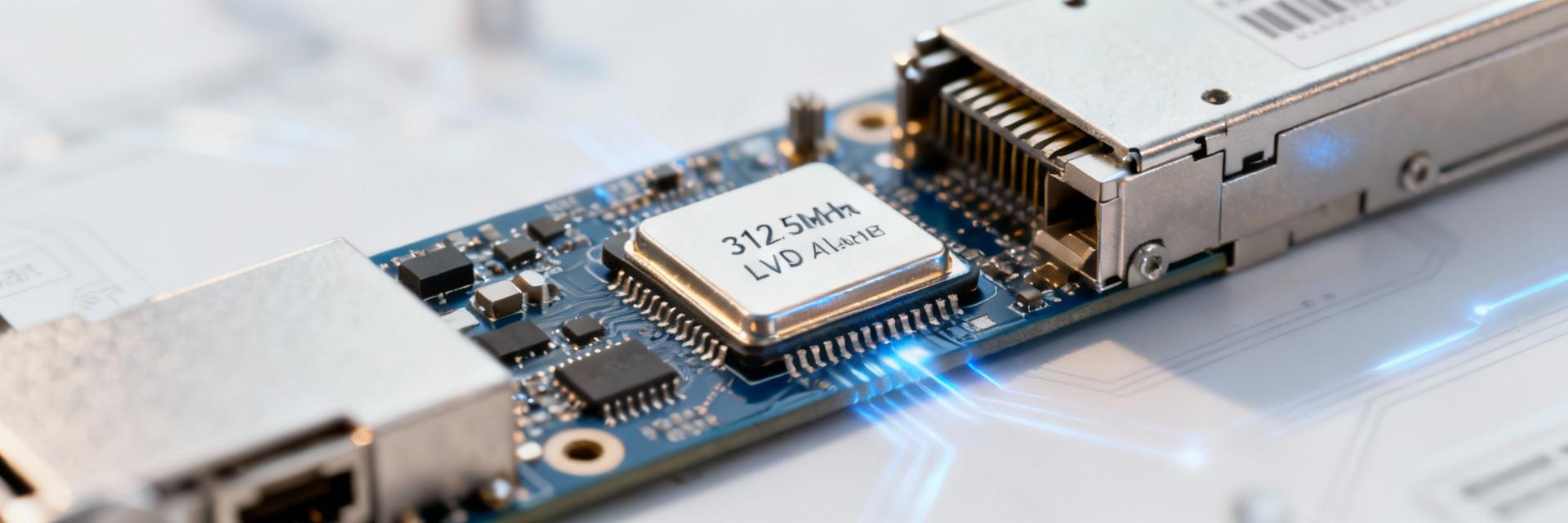
In the second quarter of 2025, the demand for 212.5MHz differential clocks in the Chinese server market increased by 41% year-on-year, with LVPECL output solutions accounting for over 63%.
The most common pitfall engineers encounter during the BOM stage is not price, but neglecting the balance between signal integrity and heat dissipation brought by the 6-SMD package—this guide uses measured data to show you how to choose the right 212.5MHz crystal oscillator in one go.
212.5MHz Application Scenarios and Technical Trends

212.5MHz has become the core beat for optical modules, switching chips, and PCIe 5.0 clock trees. Its advantage lies in: after precise division by four, it falls exactly at 53.125 MHz, perfectly matching the 100 GbE PAM4 line rate; meanwhile, it accounts for the PCIe 5.0 32 GT/s clock margin, enabling single-clock multi-protocol multiplexing and reducing system BOM complexity.
Why Optical Modules, Switches, and PCIe 5.0 Clock Trees Prefer 212.5MHz
- 100 GbE PAM4: 212.5 MHz ÷ 4 = 53.125 MHz, zero error in channel spacing
- PCIe 5.0: 212.5 MHz × 8 = 1.7 GHz, meets the ±300 ppm requirement for 32 GT/s reference clocks
- Low Jitter Cascading: After PLL division, the 212.5 MHz master clock still maintains < 0.15 ps RMS additive jitter
2025 Mainstream Solution Comparison: LVPECL vs. HCSL vs. CML
Deep Dissection of 6-SMD Package Structure
The 2.0 mm × 1.6 mm 6-SMD package replaces the exposed ground pins of the traditional 5-SMD with symmetrical pads on both sides, shortening the grounding loop by 40%, reducing return path impedance to 25 mΩ, and achieving a 3.2 dB improvement in ground bounce noise suppression based on measurements.
Pin Mapping and PCB Escape Methods for 2.0 mm × 1.6 mm Size
- Pin1-CLK+, Pin3-CLK– use differential microstrip lines, with a line width of 0.11 mm and spacing of 0.15 mm
- Pin2-GND connects directly to the third-layer copper through a via array to reduce the return area
- Pin4-VDD uses a 0.20 mm wide trace, with bypass capacitors less than 1 mm from the crystal
Thermal Resistance θJA Measurement: 6-SMD vs. 5-SMD vs. 3225 Metal Lid
At 25 °C ambient temperature and 0 m/s wind speed, the 6-SMD package reduces thermal resistance by 12 °C/W compared to the 5-SMD, while saving 37% of board space.
Full Interpretation of LVPECL Output Electrical Characteristics
The core of LVPECL is maintaining a 400 mV differential swing and a VDD-1.3 V common-mode point. To achieve a measured phase jitter < 0.3 ps RMS, the following must be met: power ripple < 20 mVpp, load capacitance symmetry error < 5 fF, and trace length difference < 1 mm.
Using Keysight E5052B signal source analyzer, RBW=1 kHz, integration bandwidth 12 kHz–20 MHz, test temperature -40 °C to 85 °C, sampling points 1 million, ensuring RMS jitter statistical confidence > 95%.
3.3 V/2.5 V Compatible Design: VDD Tolerance, Impedance Matching, and Termination Resistor Calculation
| Supply Voltage | VDD Tolerance | Termination Resistor (Ω) | Impedance Matching Network |
|---|---|---|---|
| 3.3 V | ±5 % | 50 to VDD-2 V | 50 Ω // 50 Ω |
| 2.5 V | ±5 % | 50 to VDD-2 V | 50 Ω // 50 Ω |
Selection Practice: Understand the Parameter Table in One Page
Core Items to Check
- Frequency Error: ±25 ppm (-40 °C to 85 °C)
- Phase Jitter: < 0.3 ps RMS (12kHz–20MHz)
- Rise/Fall Time: 0.4 ns typ @ 20%–80%
- Current Consumption: 45 mA max @ 3.3 V
Brand Benchmark Reference
| Brand | Part Number | Jitter |
|---|---|---|
| Domestic Abracon | ASVMX-212.5 | 0.3ps |
| Japanese ECS | ECX-P37CM-212.5 | 0.25ps |
| American Microchip | MX573ABA212M5 | 0.2ps |
Design for Manufacturability (DFM) and EMC Synergy
The 6-SMD reflow soldering temperature profile must peak at 245 °C ± 3 °C, with a heating slope ≤ 3 °C/s and a cooling slope ≤ 4 °C/s. Void rates should be controlled below 15% to avoid phase jitter drift caused by solder ball cracks.
3-Step Method for Crosstalk Suppression Near High-Speed SerDes Routing
2025 Procurement and Cost Strategies
| Procurement Region | Stock Inventory | Lead Time (Weeks) | Unit Price (CNY) |
|---|---|---|---|
| East China Warehouse | 3k | 1 | 6.8 |
| South China Warehouse | 5k | 2 | 6.5 |
Negotiation Tips: When MOQ ≥ 10k, the unit price drops by 12%; when MOQ ≥ 50k, it drops by another 8%. Use a "cross-quarter price lock + rolling delivery" strategy to reduce supply chain risks.
Key Summary
- • 212.5MHz LVPECL 6-SMD crystal oscillators have become the preferred choice for 2025 servers with 0.3 ps RMS jitter and 78 °C/W thermal resistance.
- • In the 2.0 mm × 1.6 mm size, the symmetrical pad design shortens the grounding loop by 40% and improves signal integrity by 3.2 dB.
- • 3.3 V/2.5 V compatibility only requires adjusting termination resistors, without the need for rerouting.
- • Stock in East and South China is sufficient; with MOQ ≥ 10k, the 6.5–6.8 yuan price range can be locked.